· nervico-team · product-development · 10 min read
Vibe Coding vs. Needfinding: Why We Build Solutions to Non-Existent Problems
Vibe coding makes it temptingly easy to build polished products nobody needs. Learn to distinguish between satisfying code and real solutions.
You just finished your most satisfying programming session in months. The code flows, the abstractions are elegant, the architecture is clean. You feel like an artist who just completed their masterpiece.
But there’s a problem: nobody’s going to use what you just built.
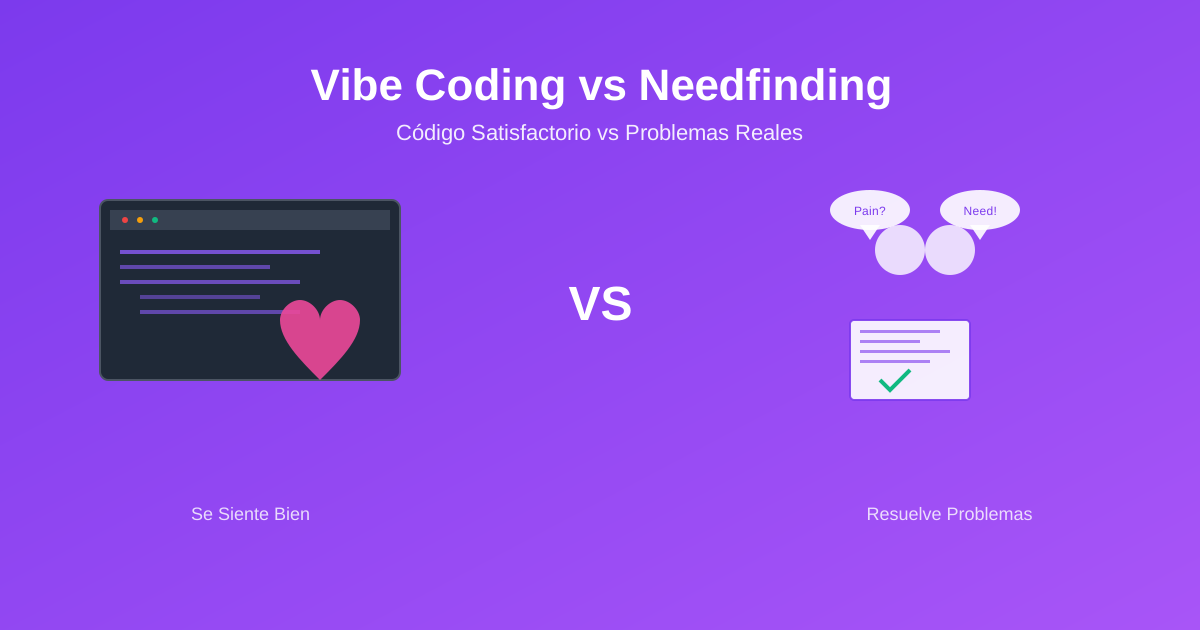
Welcome to the seductive world of “vibe coding” – that way of programming that feels incredibly good but builds solutions to problems that don’t exist. It’s the difference between writing code that emotionally satisfies you and solving problems that actually matter.
In my years helping startups and companies build technical products, I’ve seen this pattern again and again. Brilliant teams building impressive things that nobody wants. The difference between success and failure isn’t in code quality. It’s in understanding the difference between vibe coding and real needfinding.
What is vibe coding
The real definition
Vibe coding is when you build something because it feels good to programme it, not because it solves a real problem. It’s code motivated by developer satisfaction, not user needs.
Characteristics of vibe coding:
- Feels incredibly satisfying to write
- Uses the most interesting technologies of the moment
- Has elegant architecture and clean code
- Impresses other developers
- Rarely solves real user problems
It’s the difference between building a cathedral and building a shelter. The cathedral is more beautiful, but the shelter saves lives.
Why it’s so seductive
Vibe coding is addictive because it feeds our developer ego. It makes us feel smart, creative, technically superior. It’s intellectual masturbation disguised as productivity.
The dopamines of vibe coding:
- “Wow, this abstraction is elegant”
- “Nobody else could have thought of this”
- “This code is poetry”
- “I’m using the most advanced technology”
- “Other developers are going to be impressed”
The problem is these dopamines don’t correlate with real value for users. You can have the most beautiful code in the world and still have zero users.
Real-life examples
The perfect internal framework: You spent 3 months building an ultra-flexible configuration system that can handle any imaginable edge case. In reality, your application only needed 5 simple configurations.
Premium micro-architecture: You split your application into 47 microservices because “it’s more scalable”. Your application has 12 users.
Universal abstraction: You created a library that can generate any type of form imaginable. Your users only need a contact form.
Preventive over-engineering: You optimised your database to handle millions of records. Your main table has 200 rows.
What is real needfinding
The practical definition
Real needfinding is the systematic process of discovering genuine problems people have and are willing to pay to solve. It’s not asking people what they want. It’s observing what they actually do.
Real needfinding includes:
- Direct observation of behaviours
- Identification of problematic workflows
- Quantification of real pain
- Validation of willingness to pay
- Prioritisation based on impact and frequency
The fundamental difference
Vibe coding starts with “what would be cool to build?” Needfinding starts with “what real problem is preventing people from doing their job?”
Vibe coding process:
- “This technology looks interesting”
- “What could I build with it?”
- “Surely someone will find this useful”
- Build first, validate later
Needfinding process:
- “What processes do I observe that are painful?”
- “Are people using strange workarounds?”
- “Would they be willing to pay for a solution?”
- Validate first, build later
Signs of real needfinding
Obvious pain: People actively complain about the current problem Existing workarounds: They’ve already invented homemade solutions Willingness to pay: They pay for imperfect alternatives Urgency: They can’t do their job without a solution Frequency: The problem arises constantly
If you can’t identify these five signs, you’re probably doing vibe coding disguised as needfinding.
Why vibe coding is so common
Tools make it easy
Modern development tools have eliminated the friction to build. You can have a working prototype in minutes, a deployed application in hours, and a technically impressive product in weeks.
But technical ease doesn’t mean adoption ease. In fact, there’s an inverse correlation: the easier it is to build something, the more likely you are to build something nobody needs.
The tools paradox:
- 2005: Taking 3 months to build something guaranteed it was worth doing
- 2026: You can build 10 things in a day, 9 will be useless
Immediate gratification vs. real feedback
Vibe coding gives immediate gratification. You see your code working, feel progress, experience the satisfaction of creation.
Needfinding gives late and often painful feedback. You discover your idea doesn’t work, people don’t understand the problem, they’re not willing to pay.
Timeline comparison:
- Vibe coding: Gratification in minutes
- Needfinding: Feedback in weeks or months
Human nature pushes us toward immediate gratification, even when we know delayed feedback is more valuable.
The “ship fast” culture
The mantra of “ship fast and iterate” has created a culture where building fast is confused with validating fast. But they’re not the same thing.
Ship fast (misinterpreted): Build features quickly Ship fast (correct): Validate hypotheses quickly
You can validate hypotheses without writing code. In fact, it’s faster and cheaper.
How to do effective needfinding
Step 1: Direct observation
Don’t ask people what they need. Observe what they do when they think nobody’s watching.
Observation techniques:
- Shadow users: Sit with real users while they work
- Workflow mapping: Document step-by-step how they complete tasks
- Pain point inventory: List everything that makes them sigh, complain or seek workarounds
- Time tracking: Measure how much time they spend on frustrating tasks
Red flags in observation:
- Only talking to “power” users who aren’t representative
- Observing in artificial environments (demos, not real work)
- Relying on what they say instead of what they do
Step 2: Quantify the pain
Not all problems are worth solving. You need to quantify how painful the problem really is.
Pain metrics:
- Frequency: How many times per week/day does it occur?
- Duration: How much time do they lose each time?
- Workarounds: What do they currently do to solve it?
- Opportunity cost: What can’t they do because of this problem?
Quantification framework:
Pain Score = Frequency × Duration × Number of affected peopleIf your Pain Score is low, it’s probably disguised vibe coding.
Step 3: Validate willingness to pay
People say they want many things. But they only pay for what they really need.
Willingness to pay tests:
- Presell: Sell before building (landing page + waiting list)
- Time investment: Would they dedicate personal time for beta testing?
- Switching cost: Would they change from their current solution?
- Budget allocation: Do they have budget allocated for this?
Authentic signals:
- They ask when it will be available
- They give you access to their systems for integration
- They put you in touch with other potential users
- They offer to pay for a prototype
Step 4: Build minimum viable
Once the problem is validated, build the minimum solution that solves it. Not the most elegant, not the most scalable, not the most impressive. The minimum.
Minimum construction principles:
- One core function, not ten
- Manual before automated
- Ugly but functional
- Specific to initial user, not generic
Minimality test: If you can remove a feature and the product still solves the core problem, remove it.
The hidden costs of vibe coding
Opportunity cost
Every hour you spend on vibe coding is an hour you don’t spend understanding real problems. In startups, time is your most limited resource.
Real calculation:
- 40 hours of vibe coding = 1 week
- 40 hours of needfinding = 20 interviews = identification of 3-5 real problems
- Result: One week lost vs. 6-month roadmap validated
Product debt
Vibe coding creates “product debt” – code that works technically but doesn’t solve real problems. This debt is more expensive than technical debt because there’s no return on investment.
Product debt symptoms:
- Features nobody uses
- Perfect code that generates no revenue
- Elegant abstractions without purpose
- Architecture prepared for users who never arrive
Long-term team morale
Initially, vibe coding feels great. But eventually, building things nobody uses destroys team morale.
The destructive cycle:
- Build something technically impressive
- Nobody uses it
- Rationalise: “They don’t know how to appreciate quality”
- Build something even more impressive
- Repeat until the money runs out
Real cases: vibe coding vs. needfinding
Case 1: The productivity startup
Vibe coding approach: “Let’s build the definitive productivity app with AI, blockchain and augmented reality.”
Result: 18 months of development, $500k spent, 47 users.
Needfinding approach: Observed that managers spent 3 hours weekly manually copying data between Slack and Notion.
Result: Simple bot connecting Slack with Notion, $50k ARR in 6 months.
Case 2: The e-commerce platform
Vibe coding approach: “Let’s build an e-commerce system that can handle any type of product, with scalable microservices.”
Result: 2 years of development, system that can theoretically handle Amazon, used by a 50-product shop.
Needfinding approach: Identified that small shops lost 20% of sales because they couldn’t process WhatsApp orders efficiently.
Result: WhatsApp chatbot processing orders, used by 200+ shops in 8 months.
Case 3: The internal tool
Vibe coding approach: “Let’s build an internal framework that unifies all our microservices with a custom DSL.”
Result: 6 months of development, framework nobody understands except who built it.
Needfinding approach: Observed that developers lost 2 hours daily debugging configuration problems between services.
Result: Simple script validating configurations, debug time reduced 80%.
How to transition from vibe coding to needfinding
For individual developers
Step 1: Brutal audit List everything you’ve built in the last 6 months. For each thing, answer:
- How many people actually use it?
- What specific problem does it solve?
- Would people pay for this?
If the answers make you uncomfortable, you’re doing vibe coding.
Step 2: Time tracking For one week, track how much time you spend:
- Writing code
- Talking to users
- Observing real workflows
- Validating assumptions
If >80% is writing code, you’re optimising the wrong metric.
Step 3: User exposure Commit to spending at least 4 hours weekly observing real users use your product. Without doing demos. Observing real work.
For teams
Meeting structure change:
- Old: “What features can we build this week?”
- New: “What problems did we validate this week?”
Success metrics change:
- Old: Features shipped, code written, story points completed
- New: Problems validated, users interviewed, hypotheses tested
Review process change:
- Old: Code reviews
- New: Problem-solution fit reviews
The right balance
When vibe coding is acceptable
Not all vibe coding is bad. It’s acceptable when:
Learning exploration: You’re learning a new technology you’ll eventually use to solve real problems.
Technical debt repayment: You’re improving existing architecture that already solves validated problems.
Innovation time: You have 20% time dedicated to exploration, but 80% is focused on needfinding.
Team bonding: Occasionally, building something “cool” together improves team chemistry.
The 80/20 rule
80% needfinding: Understanding problems, validating solutions, building MVPs based on real pain.
20% vibe coding: Exploring, experimenting, improving architecture, learning new technologies.
If your ratio is inverted, you’re building a hobby, not a product.
Conclusion
The difference between startups that scale and startups that fail isn’t in their code quality. It’s in their ability to resist the seduction of vibe coding and focus on real needfinding.
Vibe coding feels like progress, but it’s progress in the wrong direction. It’s building the most beautiful bridge in the world to an island where nobody wants to live.
Real needfinding is harder, slower, and more frustrating. But it’s the only way to build products people actually want.
Rules of effective needfinding:
- Observe before building: 10 hours of observation save 100 hours of useless development
- Quantify the pain: If you can’t measure the problem, you can’t measure the solution
- Validate willingness to pay: Words lie, money doesn’t
- Build minimum: Elegance comes after adoption
- Resist vibe coding: It’s more addictive than cocaine and more destructive for startups
The most beautiful code you’ll ever write will be useless if it doesn’t solve a real problem. The ugliest code you’ll ever write will be valuable if it solves a problem that really matters.
The next time you feel inspired to build something “cool”, ask yourself: Is this vibe coding or needfinding? Your honest answer will determine whether you build a product or a hobby.
Is your team doing vibe coding without realising it?
We conduct product-market fit audits for technical teams. In 2 hours we identify if you’re building for real problems or developer satisfaction.